Leasing vs. Buying: A Landscaper’s Guide to Equipment Finance in 2026
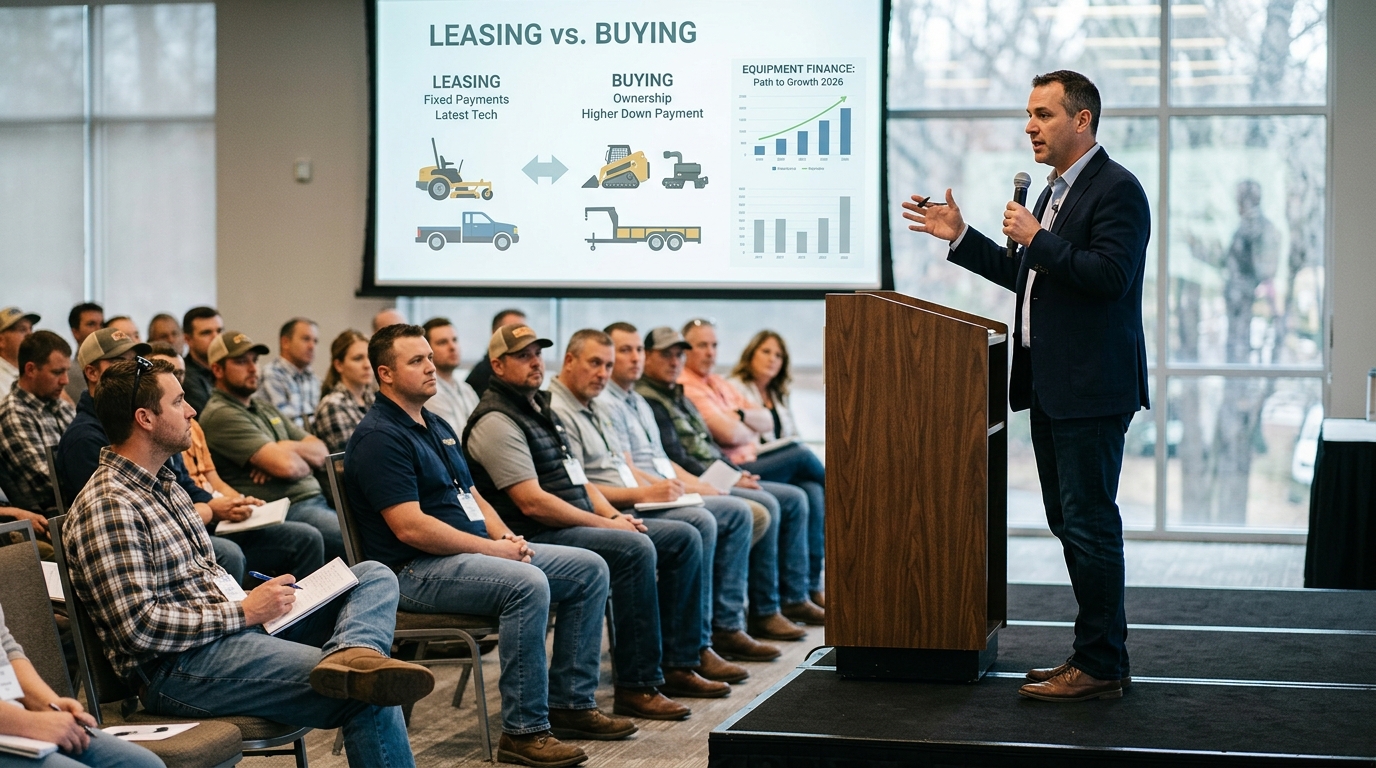
Should You Lease or Buy Your Landscaping Equipment in 2026?
For most landscaping businesses in 2026, you should buy if you prioritize long-term asset ownership and tax deductions, but you should lease if preserving cash flow and frequent upgrades are your main goals.
[Check your financing rates here]
Deciding between these two paths determines how quickly you can scale your crew without choking your bank account. Buying equipment typically requires a higher upfront capital commitment—often 10% to 20% down—but the equipment eventually becomes a debt-free asset on your balance sheet. In 2026, with the high volume of commercial mower loans for small businesses available, buying allows you to leverage Section 179 tax deductions, where you can potentially write off the full purchase price of equipment in the year you buy it, significantly lowering your tax burden.
Conversely, heavy machinery leasing for lawn care offers a predictable monthly expense that is easier to forecast during the unpredictable, seasonal lulls of the landscaping calendar. When you lease, you are effectively renting the asset for a set term. At the end of the term, you can often buy it out for a nominal fee (like $1) or a fair market value. This is ideal if you operate skid steers or zero-turn mowers that take heavy abuse and need frequent replacement. Because leasing often requires less cash upfront, it keeps your working capital free for other essential costs, such as payroll, fuel, and marketing, which are critical when you are trying to capture market share in a competitive season.
How to qualify
To secure the best landscaping equipment financing in 2026, you need to prove that your business is stable enough to handle the debt service. Lenders are not just looking at the equipment; they are underwriting your ability to generate consistent revenue.
- Credit Score Requirements: Most prime lenders look for a FICO score of 650 or higher. If your score is below 600, you will likely need to explore bad credit equipment financing for landscapers, which will likely come with higher interest rates or require a larger down payment to protect the lender’s risk.
- Time in Business: Lenders generally prefer at least 24 months of operation. If you are a startup with less than one year in business, you will likely need to provide a personal guarantee, strong personal credit, and potentially a larger down payment (20-30%).
- Annual Revenue: While minimums vary, most commercial lenders want to see at least $150,000 to $250,000 in annual gross revenue. This proves you have the cash flow to support new monthly payments.
- Documentation: Prepare your last three to six months of business bank statements, a current equipment list (if you own existing assets), and your most recent tax returns.
- The Application Process: Once your documents are ready, apply to at least three different lenders. Comparing offers is the only way to ensure you aren't overpaying on interest. Most specialized equipment lenders can provide a preliminary "soft credit pull" approval within 24 to 48 hours.
The Decision: Leasing vs. Buying
Choosing between these two options is a balance between your current cash position and your long-term fleet strategy. Use this breakdown to determine your next move.
Buy If:
- You plan to keep the equipment for its full lifespan: If you intend to run a mower for 5,000+ hours, buying is cheaper in the long run.
- You need tax deductions: If your business is profitable, the ability to depreciate the asset via Section 179 creates an immediate tax advantage that leasing cannot match.
- You have the cash: If you have liquid savings and don't want to carry a monthly liability, paying cash or financing with a large down payment reduces your operational overhead.
Lease If:
- Cash flow is tight: Leasing allows you to get a new skid steer or mower on the job site with zero or low money down.
- Technology is shifting: If you want to switch to electric mowers or autonomous equipment, leasing allows you to trade in for newer, more efficient models every 36 months without the hassle of selling used equipment.
- You hate repairs: Many leases include service agreements or ensure you are always within the factory warranty period, eliminating major surprise repair bills.
To decide, look at your net income. If your monthly cash flow is erratic, prioritize leasing to keep your fixed costs lower during the off-season. If your business is steady and you need to lower your taxable income, buying is the more efficient financial maneuver.
Frequently Asked Questions
How do zero down landscaping equipment leases work? Zero down landscaping equipment leases function by allowing you to finance the full purchase price of the machinery, including taxes and sometimes even shipping fees. While this is an excellent tool for conserving your cash flow, lenders typically require a strong credit profile—often a 700+ FICO score—to qualify. Because you aren't paying money upfront, the monthly payments will be higher than a standard loan, and the total cost of ownership over the lease term will be greater due to the interest on the full amount.
What are the current equipment financing rates for 2026? Equipment financing rates in 2026 currently fluctuate between 7% and 14% for well-qualified borrowers, depending on the asset age and your business credit history. If you are opting for bad credit equipment financing, those rates can climb into the 20% to 30% range. Always ask for the "Total Cost of Financing" rather than just focusing on the monthly payment, as a low monthly payment can sometimes mask an extremely long, high-interest term that costs you significantly more in the long run.
Are working capital loans a good alternative to equipment financing? Working capital loans for landscaping companies are generally meant for bridging temporary gaps in cash flow—like paying for insurance premiums or fuel during the winter—rather than buying major machinery. These loans are usually short-term (6–18 months) and have much higher interest rates. Use equipment financing for assets that generate income (mowers, trucks, excavators) and reserve working capital loans for operating expenses that don't directly add value to your fleet.
Background: Understanding Equipment Finance
Equipment finance is essentially a way to leverage the cost of high-ticket items over their productive life. Instead of paying for a $50,000 skid steer in one lump sum, you spread that cost over 36, 48, or 60 months. This aligns the cost of the asset with the revenue it generates on the job site. The concept is simple: the mower pays for itself through the extra properties you are able to service because you have that machine.
In the landscaping industry, heavy machinery is often subject to extreme wear and tear. According to the Small Business Administration (SBA), small businesses that effectively utilize debt to manage equipment costs can scale up to 30% faster than those that rely solely on cash reserves, provided the debt service ratio remains manageable. This is because cash is the lifeblood of a landscape business, particularly during the startup or growth phase.
Another critical factor is the economic landscape. According to data from the Federal Reserve (FRED), business equipment investment has remained a core driver of productivity in the construction and services sectors as of early 2026. By utilizing equipment financing, you aren't just buying a tool; you are effectively hedge-betting against inflation. By locking in a fixed monthly payment for a piece of equipment today, you are paying for that machine with future dollars, which helps stabilize your operational budget even if fuel or labor costs fluctuate throughout the season.
Ultimately, understanding the mechanics of these loans and leases allows you to operate your business as a professional contractor rather than a hobbyist. When you treat equipment acquisition as a financial strategy rather than just a chore, you turn your fleet into a competitive advantage.
Bottom line
The choice between leasing and buying rests on your specific cash flow needs and tax strategy for 2026. Prioritize equipment financing that allows you to scale your operations immediately without draining the capital you need to survive the off-season.
Disclosures
This content is for educational purposes only and is not financial advice. landscapers.news may receive compensation from partner lenders, which may influence which products are featured. Rates, terms, and availability vary by lender and applicant qualifications.
Ready to check your rate?
Pre-qualifying takes 2 minutes and won't affect your credit score.
Frequently asked questions
Is it better to lease or buy landscaping equipment in 2026?
Buying is better if you want to build equity and utilize Section 179 tax deductions. Leasing is superior for cash flow management and upgrading to new models every few years.
Can I get landscaping equipment financing with bad credit?
Yes, specialized lenders offer bad credit equipment financing for landscapers, typically requiring a larger down payment or higher interest rates to offset the risk.
What is the typical down payment for commercial mower loans?
While zero down landscaping equipment leases exist for those with strong credit, standard commercial loans typically require 10-20% down, depending on your time in business.